Introduction
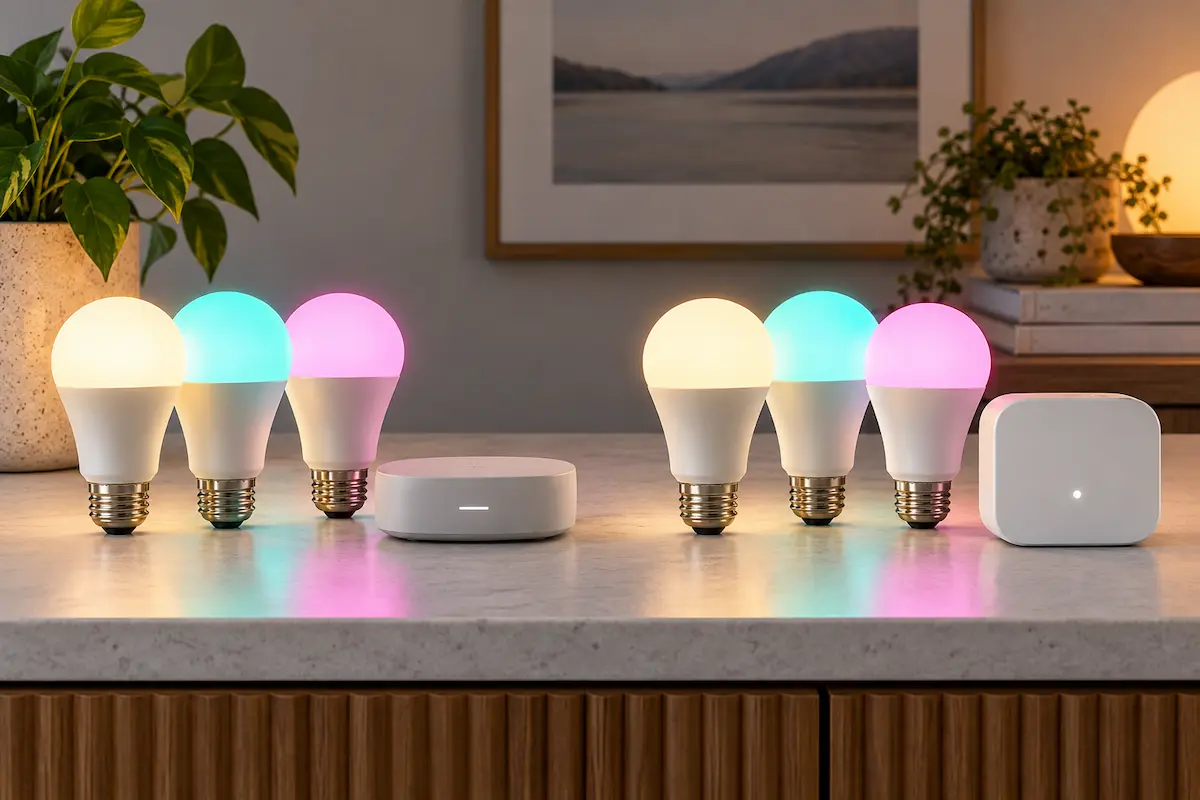
Nanoleaf Essentials vs Philips Hue compares two lighting systems that both work with Matter, but they reach it through different network designs. Current Nanoleaf Essentials A19 bulbs are offered in Matter-over-Thread and Matter-over-Wi-Fi versions, depending on the selected product. Hue bulbs generally use Zigbee and become Matter devices to other ecosystems through the Hue Bridge. The visible result may be a color-changing bulb in either case, yet commissioning, routing, accessory support, and failure behavior differ.
This comparison uses current representative A19/E26 color bulbs. Nanoleaf lists 900-lumen average and 1000-lumen maximum output for current Matter Thread/Wi-Fi models, while Hue sells several A19 brightness and color variants. Do not transfer one model’s specifications to the whole family. Confirm base, voltage, connectivity type, controller requirements, and package generation before purchase.
Quick Answer
In the Nanoleaf Essentials vs Philips Hue comparison, choose Nanoleaf Essentials if you want a direct Matter-over-Thread bulb, already own a compatible Matter controller and Thread border router, and prefer a lower-cost path to color lighting without a proprietary bridge. For another comparison featuring Philips Hue, see Philips Hue vs Govee Smart Bulbs. Choose Philips Hue if you want the mature Hue Bridge, Zigbee mesh, dedicated sensors and switches, refined routines, and easier growth toward dozens of lights. Nanoleaf is the streamlined Matter choice; Hue is the fuller lighting ecosystem.
Comparison Table
| Feature | Nanoleaf Essentials smart bulbs | Philips Hue smart bulbs |
|---|---|---|
| Matter architecture | Direct Matter over Thread or Wi-Fi by model | Matter exposed through Hue Bridge |
| Native lighting network | Thread or Wi-Fi plus Bluetooth commissioning | Zigbee; Bluetooth on supported bulbs |
| Hub requirement | Matter controller; Thread model also needs border router | Hue Bridge for full features and Matter |
| Representative output | 900 lm average / 1000 lm maximum | Varies; A19 lines include 1100-lumen options |
| Color temperature | 2700–6500 K on current representative color bulb | Varies by White Ambiance or Color model |
| Color rendering | CRI 90 or higher on current model | Model-specific; verify exact Hue bulb |
| Accessories | Sense+ and compatible ecosystem controls | Broad Hue switches, sensors, and accessories |
| Scale | Thread performance depends on border routers and topology | Hue Bridge supports up to 50 bulbs |
Nanoleaf Essentials vs Philips Hue: Key Differences
Direct Matter versus bridge-mediated Matter
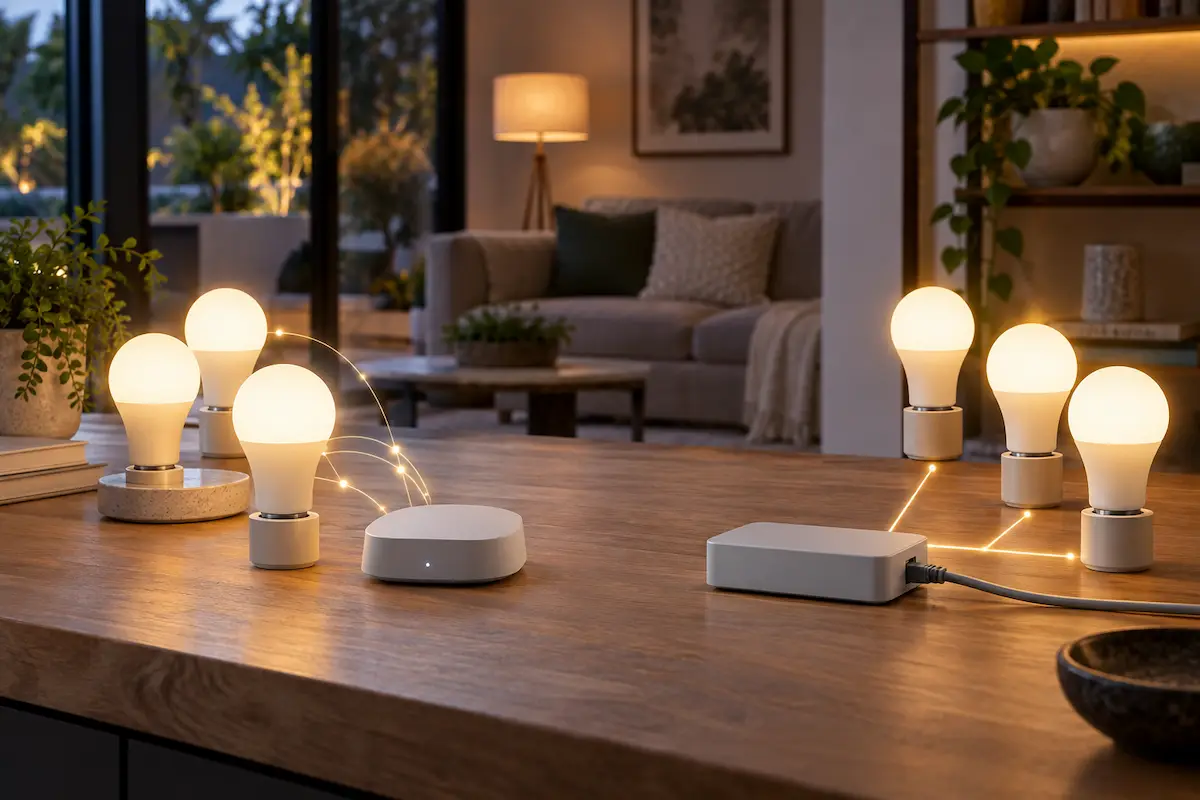
A Nanoleaf Matter-over-Thread bulb joins a Thread network and is commissioned to a Matter ecosystem through a compatible controller; the controller and border-router roles may be combined in one home hub. Hue bulbs join the Hue Bridge over Zigbee, and the Bridge exposes supported lights to Matter. Nanoleaf removes a brand-specific bridge, while Hue centralizes lighting and preserves its mature accessory system. Both still require appropriate smart-home infrastructure.
Thread and Zigbee behavior
Thread and Zigbee are both low-power mesh technologies, but they use different application and commissioning models. Powered bulbs can route traffic, so placement and always-on power matter. Turning a wall switch off removes the bulb from either mesh. Thread quality depends on compatible border routers and ecosystem implementation; Hue reliability depends on Bridge placement and Zigbee coverage. Protocol names do not eliminate poor radio conditions.
Native app features
Nanoleaf offers scenes, circadian lighting, screen mirroring, schedules, Magic Scenes, and other model-dependent functions through its app. Hue offers scenes, routines, effects, accessories, and entertainment features through Hue. Matter exposes a common subset and may not carry every proprietary scene. Keep the original app for firmware and advanced features, even when day-to-day control happens in Apple Home, Google Home, Alexa, or SmartThings.
Scaling a whole home
Nanoleaf states that Thread performance can decrease in large networks and publishes platform-dependent guidance for numbers of bulbs. Hue documents up to 50 bulbs and 12 accessories per Bridge, with additional bridges possible under supported app behavior. A few Nanoleaf bulbs can be simple when a border router already exists. A large lighting installation may be easier to reason about when dedicated to Hue’s Bridge and accessory ecosystem. Scaling is therefore a central factor in Nanoleaf Essentials vs Philips Hue.

Major Features Compared
Brightness, whites, and color
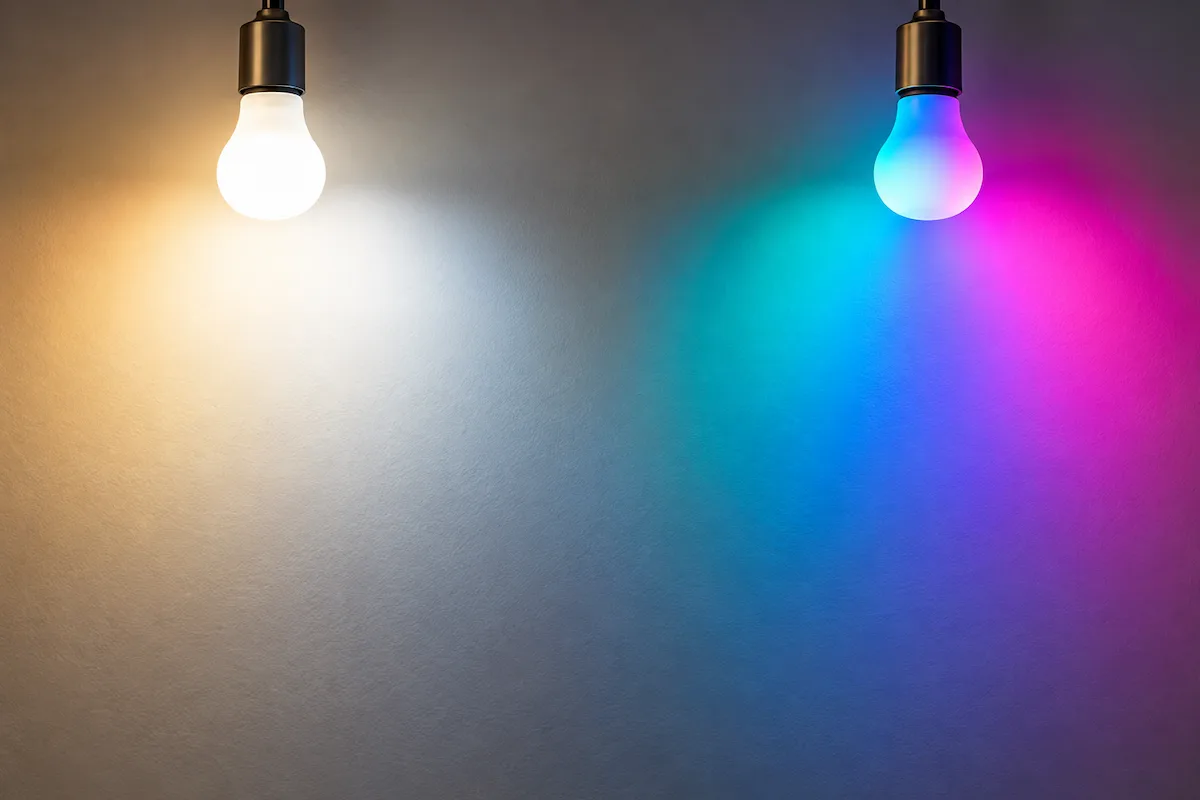
Current Nanoleaf Matter Thread/Wi-Fi A19 models list 900 lumens average, 1000 lumens maximum, 2700–6500 K whites, more than 16 million colors, and CRI 90 or higher. Hue specifications depend on model; current A19 options include higher-output 1100-lumen products and different white or color ranges. Compare the exact products at the same white temperature. Saturated color output is not represented by a maximum white-lumen figure.
Controllers and border routers
A Nanoleaf Matter-over-Thread bulb needs a Matter-compatible hub and Thread border router for smart-home ecosystem control. Examples can include supported HomePod, Apple TV, Google Nest, Amazon Echo, Samsung, or Nanoleaf devices, but compatibility evolves. For a different Philips Hue matchup, take a look at Philips Hue Lightstrip vs Govee LED Strip Lights. Hue needs the Hue Bridge for its full system and Matter connection. Inventory the hubs already in your home before assuming Nanoleaf is hub-free or Hue requires entirely new hardware.
Physical controls
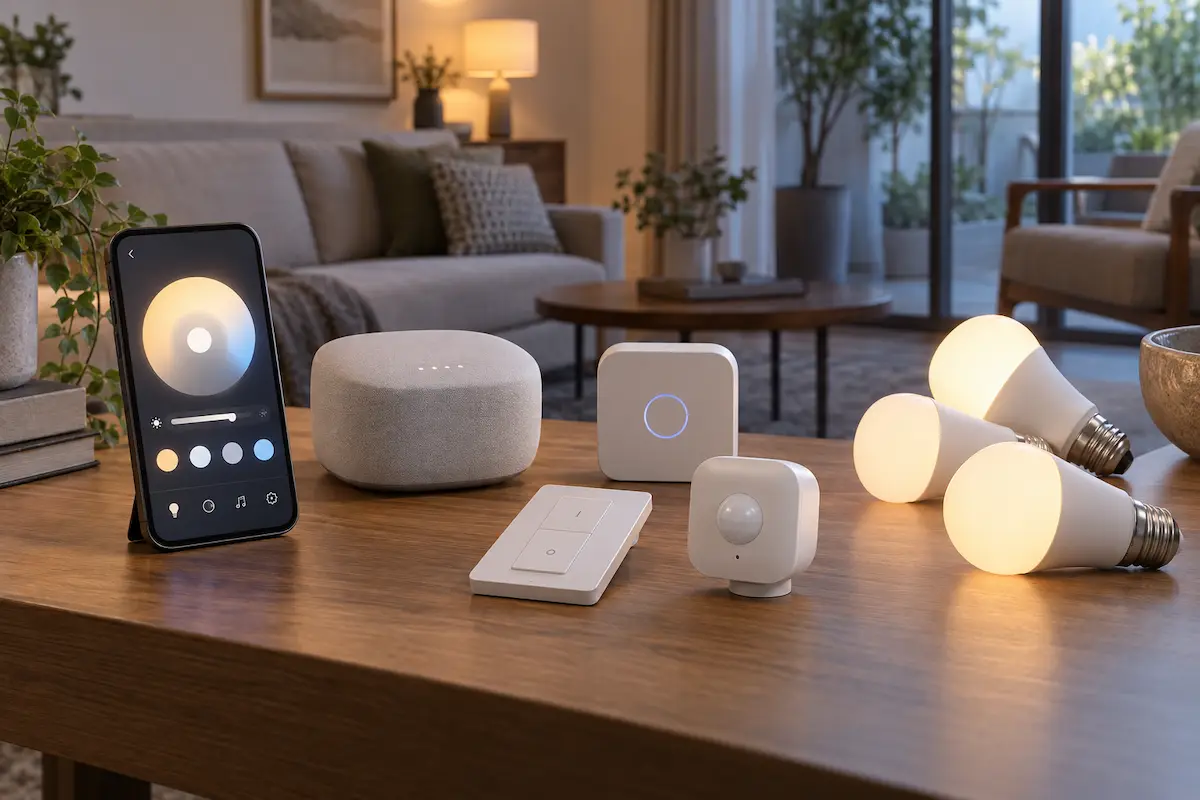
Hue has a deep catalog of remotes, wall modules, buttons, and motion sensors designed specifically for lighting. Nanoleaf supports its Sense+ control products and ecosystem automations, but the range and compatibility should be checked for the selected bulb generation. Good physical control keeps smart lights useful for guests and during phone problems. It also prevents the common mistake of cutting power at a normal switch and making the bulb unreachable.
Mixed ecosystems and multi-admin
Matter can allow a device to be shared across supported ecosystems through multi-admin commissioning. That is useful when one person uses Apple Home and another uses Google Home, but setup codes, ownership, and reset procedures need careful handling. Hue’s Bridge can present a coordinated set of lights, while individual Nanoleaf bulbs may be commissioned directly. Document which platform owns automations to avoid duplicate schedules and contradictory commands.
How to Choose for Your Home
When weighing Nanoleaf Essentials vs Philips Hue, begin with the fixture and room: confirm base type, voltage, enclosed-fixture restrictions, required brightness, color needs, and whether a wall dimmer is present. Smart bulbs generally need constant power and should not be placed on an incompatible traditional dimmer. Then choose the network architecture—direct Wi-Fi, Bluetooth, Zigbee through a bridge, or Matter over Thread—and confirm the necessary controller or border router. Consider how many lights the system must support, how guests will control them, and whether physical switches remain intuitive. Scenes and effects are useful, but stable automations, replacement availability, and consistent white light often matter more for everyday ownership.
Who Nanoleaf Essentials smart bulbs Is Best For
Nanoleaf Essentials is best for a smaller Matter-first installation that already has the right controller and border router. It offers strong representative color specifications and avoids adding a dedicated lighting bridge.
- Matter-over-Thread homes with compatible infrastructure.
- Apple, Google, Alexa, or SmartThings users wanting direct bulbs.
- Small and medium installations where bridge simplicity matters.
- Buyers interested in Nanoleaf scenes and desktop integrations.
Who Philips Hue smart bulbs Is Best For
Philips Hue is best for a lighting system expected to grow across many rooms. Our LIFX SuperColor A21 vs Philips Hue A21 1600 comparison offers another perspective on Philips Hue products. The Bridge, Zigbee mesh, dedicated controls, and extensive integrations provide a clearer operational center.
- Whole-home projects approaching dozens of bulbs.
- Users who need a broad selection of switches and sensors.
- Existing Hue Bridge households.
- Buyers prioritizing mature routines and entertainment integrations.
Frequently Asked Questions
These Nanoleaf Essentials vs Philips Hue questions cover hubs, direct Matter, mixed ecosystems, brightness, Apple Home, and offline behavior.
Do Nanoleaf Essentials Matter bulbs need a hub?
For ecosystem control, yes: they need a compatible Matter controller. Matter-over-Thread versions also require a Thread border router, which may be built into the same home hub.
Do Hue bulbs use Matter directly?
Hue’s normal architecture keeps bulbs on Zigbee and uses the Hue Bridge to expose supported lights to Matter. The Bridge is the Matter device boundary.
Can Nanoleaf and Hue bulbs work together?
Supported bulbs can appear in the same Matter ecosystem for common controls. Their proprietary scenes, firmware, and accessories remain managed in separate brand apps.
Which is brighter?
It depends on the exact bulbs. Current Nanoleaf A19 Matter models list up to 1000 lumens; Hue sells multiple outputs, including 1100-lumen A19 options. Compare color-capable models and temperatures directly.
Which is better for Apple Home?
Both can work well. Nanoleaf Matter-over-Thread can connect directly through compatible Apple Matter/Thread infrastructure; Hue connects through the Bridge. Hue offers more dedicated lighting accessories.
Will smart bulbs work when the internet is down?
Local behavior depends on the controller, app, network, and automation design. Thread, Zigbee, and Matter can support local communication, but cloud voice services and remote access may fail. Physical controls remain valuable.
Final Comparison Summary
Nanoleaf Essentials vs Philips Hue comes down to direct Matter simplicity versus a mature bridge-based ecosystem. Nanoleaf Essentials is the simpler direct-Matter choice when compatible Thread infrastructure already exists and the project needs a modest number of color bulbs. Philips Hue is the more complete lighting platform, using the Bridge to coordinate Zigbee bulbs, accessories, automations, and Matter exposure at scale. Neither architecture is universally newer or better. Count the lights, inventory existing hubs, plan physical controls, and compare exact bulb specifications before choosing the network you will maintain.