Introduction
Nanoleaf Shapes Hexagons vs Govee Glide Hexagon Light Panels Ultra compares two current products aimed at the same broad buyer, but their hardware, storage or ecosystem assumptions are not interchangeable. Nanoleaf emphasizes modular RGBW panels, touch control, mix-and-match Shapes, screen mirroring, and expansion to very large layouts. Govee's 10-panel H606A kit emphasizes multifaceted 3D effects, 129 lamp beads, six-sided patching, DreamView, Razer Chroma, and Govee Desktop.
This guide uses current manufacturer specifications and support material rather than claiming personal testing. Published detection ranges, battery estimates, brightness, audio performance, and other laboratory results depend on settings and surroundings. Confirm the exact US model, included accessories, current firmware, and subscription terms before buying, because similarly named regional packages can differ.
Quick Answer
Choose Nanoleaf Shapes Hexagons if touch interaction, tunable white, mixing Hexagons with Triangles or Mini Triangles, broad expansion, and Nanoleaf screen integrations are priorities. Choose Govee Glide Hexagon Light Panels Ultra if denser-looking multifaceted RGBIC effects, a complete 10-panel flagship kit, DreamView, and Govee gaming software matter more. Nanoleaf is the more modular design platform; Govee is the more visually aggressive gaming-light package.
Comparison Table
| Feature | Nanoleaf Shapes Hexagons | Govee Glide Hexagon Light Panels Ultra |
|---|---|---|
| Panel lighting | RGBW, 16M+ colors | RGBIC multifaceted color |
| White range | 1200–6500K tunable white | Color/effect focused; no comparable white range listed |
| Touch | Touch gestures on panels | Control box, app, and voice |
| Layout | Mix Hexagons, Triangles, Mini Triangles | Six-sided Hexagon Ultra connections |
| Expansion | Up to 500 panels per controller; PSU limits apply | 10 panels in the listed kit |
| Gaming | Screen Mirror, Razer Chroma, Overwolf | DreamView, Razer Chroma, Govee Desktop |
| Connectivity | 2.4 GHz Wi-Fi | 2.4 GHz Wi-Fi and Bluetooth |
| Indoor rating | IP20 | Indoor gaming/decor panels |
Key Differences
Flat modular canvas or 3D-style effect
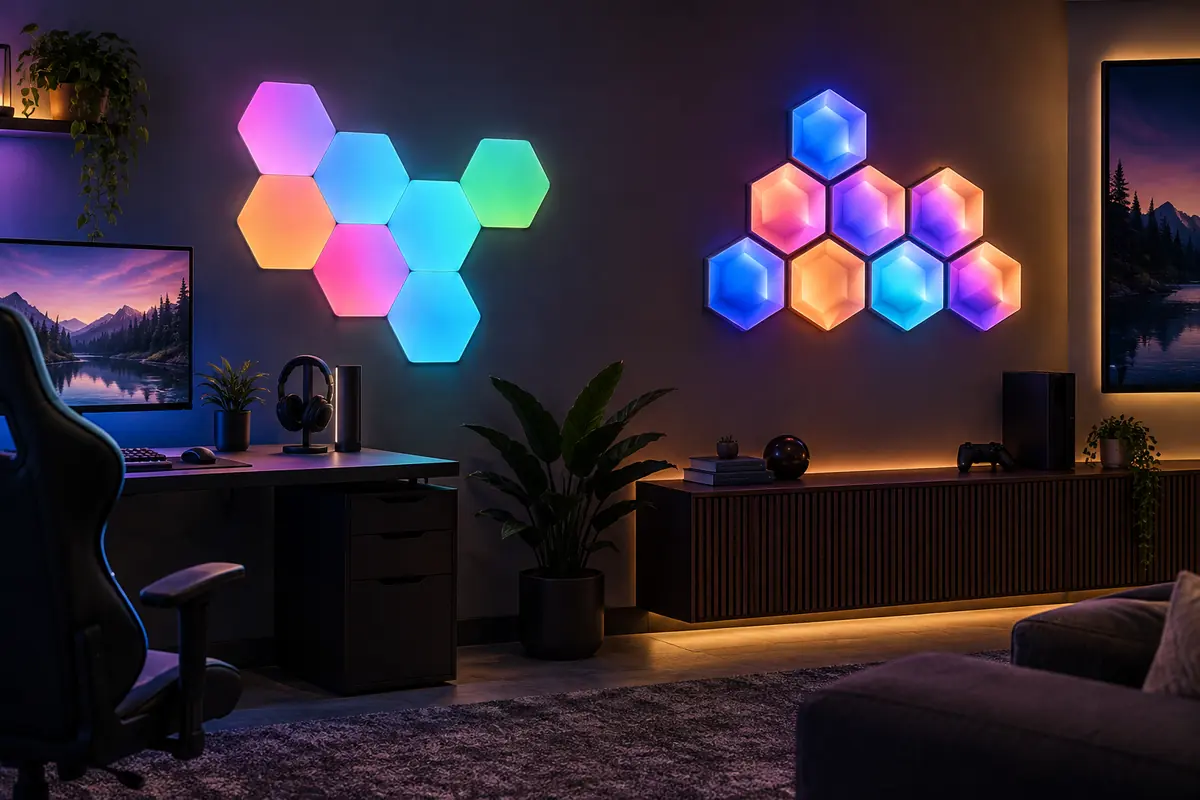
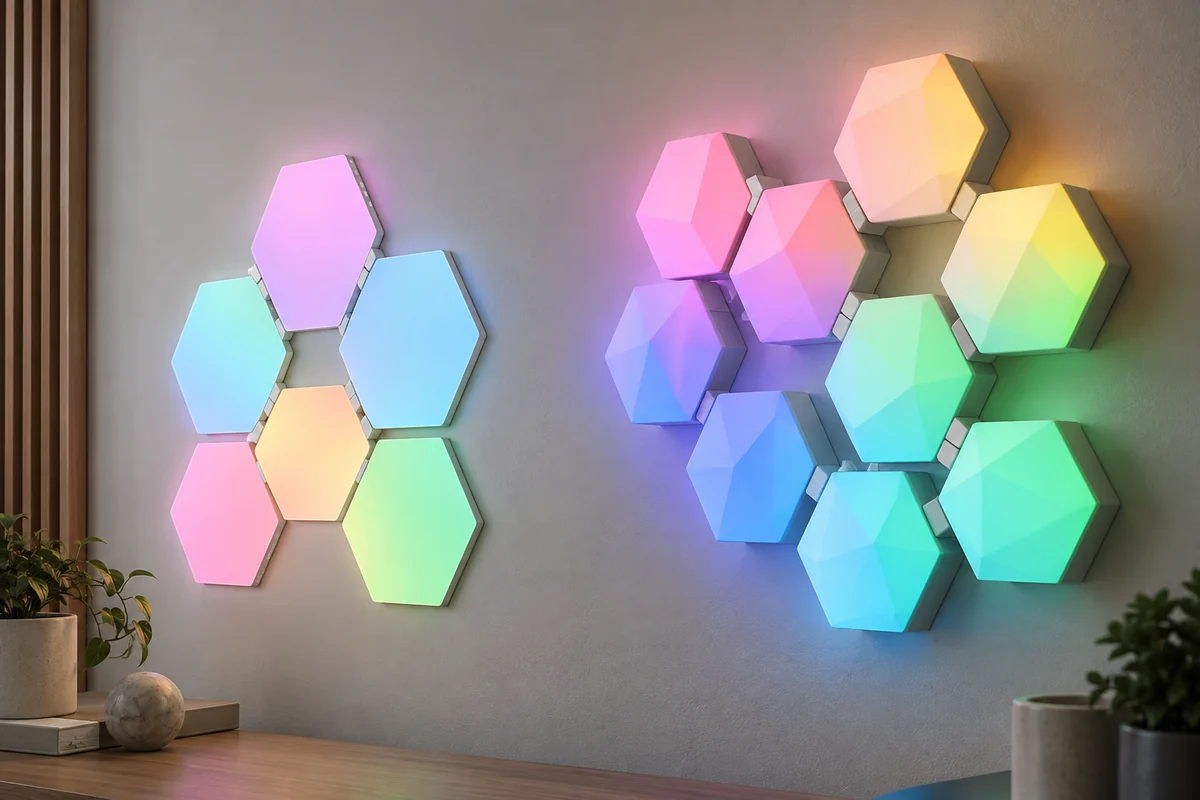
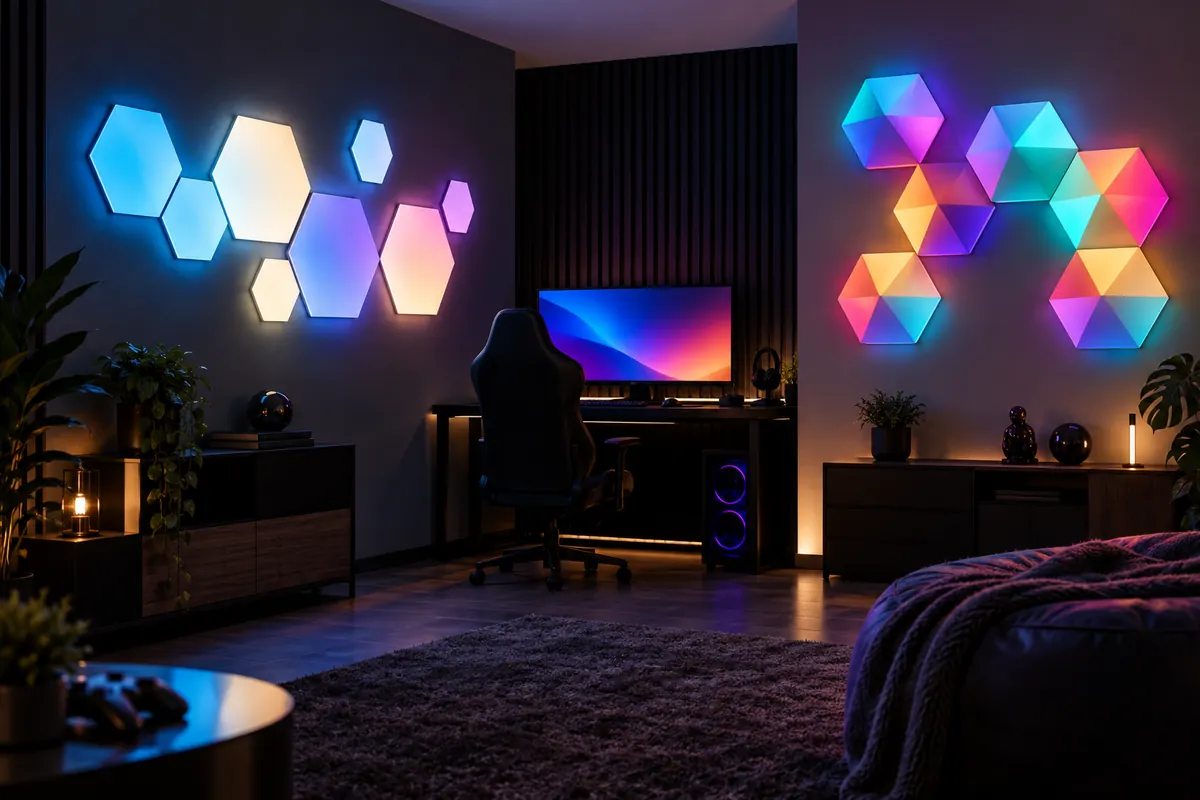
Nanoleaf's Hexagons are thin RGBW wall panels that emphasize a continuous customizable layout. Govee Ultra divides light into multifaceted surfaces and lines, using RGBIC effects to create more apparent depth. Nanoleaf can look like illuminated wall art; Govee aims for a high-energy gaming backdrop. To compare more Govee options, see our Philips Hue Signe Gradient Floor Lamp vs Govee Floor Lamp 2 guide. Product photos are captured under controlled exposure, so evaluate how the unlit panels and cable routing will look in ordinary daylight.
Touch and white light
Nanoleaf provides touch gestures and a documented 1200–6500K tunable-white range with RGBW channels. Govee lists app, control-box, and voice operation and focuses on RGBIC effects rather than an equivalent white-light specification. Touch can make wall art interactive without a phone, while Govee's approach favors programmed scenes. Neither system should be selected as the room's only high-quality task lighting.
Expansion rules
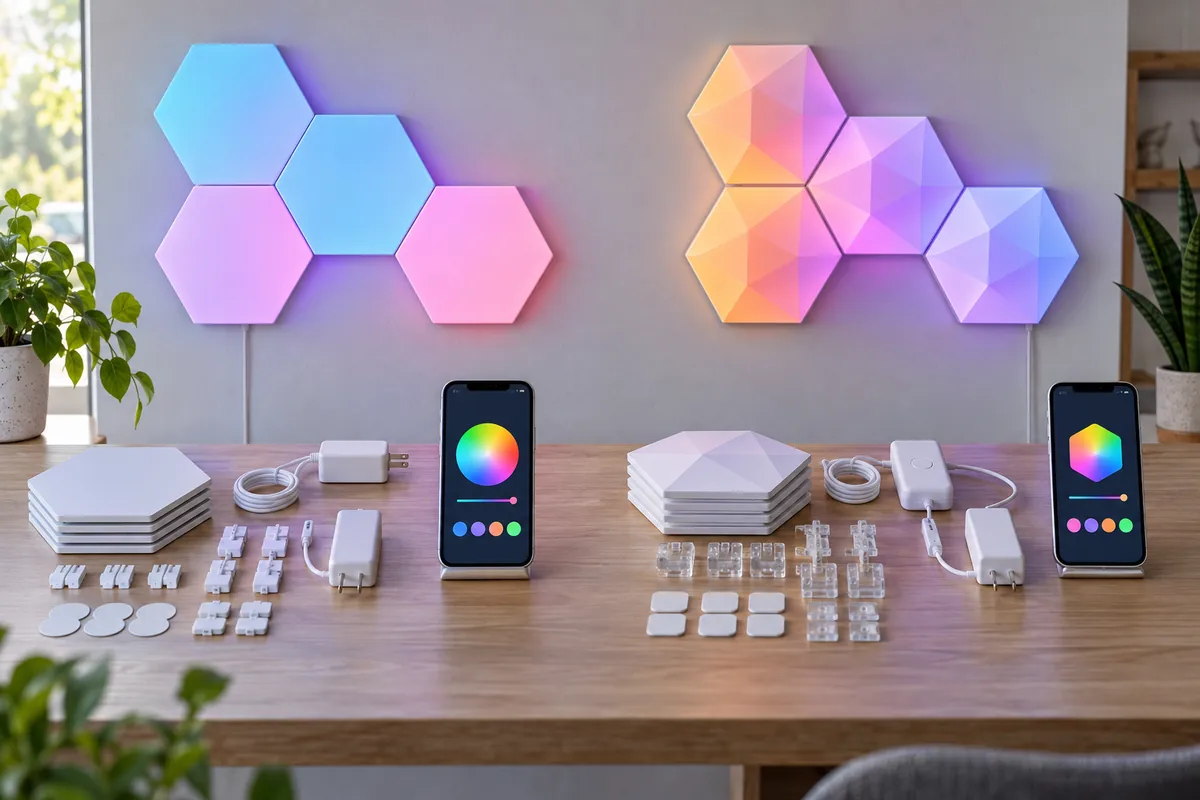
Nanoleaf Connect+ lets Hexagons, Triangles, and Mini Triangles share a layout, with up to 500 panels on one controller but far lower per-power-supply limits—for white Hexagons, Nanoleaf lists 21 on a 42 W supply. Govee Ultra allows connections on all six sides within its system and ships as a 10-panel H606A kit. Do not mix power supplies, linkers, or panels between brands or incompatible generations.
Gaming and screen software
Both support Razer Chroma. Nanoleaf also promotes Screen Mirror, Overwolf, and its desktop app; Govee offers DreamView, Govee Desktop, and its wider lighting ecosystem. Supported games, operating systems, capture methods, latency, and network discovery change the experience. Native scenes work without a PC, while accurate screen matching may require background software and permissions that should be reviewed.
Major Features Compared
Everyday performance and its limits
Nanoleaf lists 100 lumens per white Hexagon panel, CRI 80, and 25,000-hour LED life. Govee lists 129 lamp beads and 72 W for the H606A package but not a directly comparable per-panel lumen rating. These products are decorative; animation smoothness, color transitions, diffuser uniformity, and layout visibility matter more than treating raw electrical or LED counts as brightness scores. Manufacturer numbers are useful for identifying design intent, but they are not a substitute for placement, setup, and maintenance. Compare the complete workflow rather than awarding the decision to one larger number.
Apps, ecosystems, and privacy
Nanoleaf supports its mobile and desktop apps plus major assistants and gaming integrations, with feature availability varying by controller and platform. Govee uses Govee Home, DreamView, desktop tools, voice, Wi-Fi, and Bluetooth. Check the exact platform controls exposed outside each brand's app; complex multi-zone scenes, touch gestures, and screen effects typically do not translate fully into generic smart-home commands. For a different Nanoleaf matchup, take a look at Nanoleaf Essentials vs Philips Hue. Platform support can change by region or firmware. Protect the account with a unique password and multifactor authentication where offered, review household permissions, and enable only the cloud or sensing functions you plan to use.
Installation and long-term ownership
Plan the complete layout on a template before attaching anything. Clean and test the wall finish, locate studs if using screw mounts, keep the controller reachable, and route power without stretching linkers. Adhesive performance varies with paint, texture, humidity, heat, and age. Large arrays can damage paint during removal, so renters should test a hidden area and preserve spare mounting supplies. Before the return window closes, test the difficult real-world conditions, document settings that work, and price required accessories or consumables. A product that is easy to service is usually a better long-term choice than one with an impressive feature you rarely use.
How to Choose for Your Home
Start with the physical installation: base or fixture type, voltage, brightness, indoor rating, wall space, and any incompatible dimmer. Then choose the network architecture—direct Wi-Fi, Bluetooth, Zigbee through a bridge, or Matter—and confirm every required controller. Consider how guests will operate the light, what happens when the internet is down, and whether physical switches remain intuitive. Effects are fun, but stable automations, consistent white light, replacement availability, and a clean installation usually matter more in daily use.
Who Nanoleaf Shapes Hexagons Is Best For
Nanoleaf Shapes Hexagons is the more natural choice when its defining hardware and platform match the way the product will be used every day.
- Designers who want to mix three compatible Shapes families.
- Users who value touch gestures and tunable white.
- Large-layout planners willing to calculate power-supply limits.
- Nanoleaf, Razer, Overwolf, or screen-mirroring users.
Who Govee Glide Hexagon Light Panels Ultra Is Best For
Govee Glide Hexagon Light Panels Ultra makes more sense when its different balance of capability, storage, controls, and maintenance solves the more important problem. Our Philips Hue Lightstrip vs Govee LED Strip Lights comparison offers another perspective on Govee products.
- Gaming rooms prioritizing multifaceted 3D-style RGBIC effects.
- Govee DreamView and Govee Desktop households.
- Buyers wanting the listed 10-panel flagship package.
- Layouts that benefit from connections on all six sides.
Frequently Asked Questions
Can Nanoleaf and Govee panels connect together?
No. Their linkers, controllers, power systems, software, and electrical requirements are proprietary. They may share a room or smart-home voice platform, but each installation must remain within its own compatible hardware family.
Can Nanoleaf Shapes mix different panel shapes?
Yes. Nanoleaf's Connect+ system allows compatible Shapes Hexagons, Triangles, and Mini Triangles in one layout. Controller and power limits still apply, and older Nanoleaf product families are not automatically compatible.
How many Govee panels are in the Ultra kit?
The current H606A US listing describes ten light panels with ten linking cables, an adapter, control box, connection cable, level, and manual. Confirm the exact retailer package rather than assuming expansion hardware is identical.
Which panels are brighter?
Nanoleaf publishes 100 lumens per white Hexagon, while Govee emphasizes LED count and effect design without a directly comparable lumen figure on the product page. Decorative contrast and wall placement matter more than a forced numerical winner.
Will the adhesive damage paint?
It can. Paint age, preparation, texture, humidity, and removal technique all matter. Follow mounting instructions, test a hidden area, avoid weak or recently painted surfaces, and consider approved screw hardware where long-term security matters.
Do screen effects work without a computer?
Built-in scenes and music modes can work through controllers and apps, but screen mirroring or desktop gaming integrations generally require supported software, network access, and a running source device. Verify the exact platform and game before purchase.
Final Comparison Summary
Nanoleaf Shapes Hexagons are the better modular wall-light system for owners who want touch, tunable white, mixable panel shapes, and an expansion path governed by clear controller and power limits. Govee Glide Hexagon Light Panels Ultra are the bolder effect product, using multifaceted RGBIC lighting and a 10-panel kit designed around DreamView and gaming integrations. Choose the software and physical layout first. Then calculate power, mounting, cable visibility, and removal risk before attaching either system to the wall.