Introduction
JBL Authentics 500 vs Denon Home 350 is a useful comparison because both products pursue the same job with different hardware and ecosystem assumptions. These large mains-powered wireless speakers target serious room-filling playback. JBL adds Dolby Atmos Music and the unusual ability to run Alexa and Google Assistant together; Denon uses a six-driver stereo layout, HEOS multiroom, and broader physical inputs including USB, analog, and Ethernet.
This buying guide uses current US manufacturer specifications and support material; it does not claim personal testing. Published battery, detection, suction, brightness, and coverage figures depend on settings and conditions. Confirm the exact model, included accessories, firmware, and subscription terms before ordering.
Quick Answer
Choose JBL Authentics 500 if Dolby Atmos Music, simultaneous Alexa and Google Assistant availability, Chromecast built-in, and JBL’s retro-modern design are decisive. Choose Denon Home 350 if HEOS multiroom, a conventional wide stereo architecture, USB and analog inputs, Ethernet, Roon readiness, or integration with compatible Denon receivers matters more. JBL is the stronger smart-assistant and immersive-music proposition. Denon is the more traditional connected hi-fi component. Neither has a battery, and neither should be selected before checking service availability and the room space required by a large speaker.
Comparison Table
| Feature | JBL Authentics 500 | Denon Home 350 |
|---|---|---|
| Core audio | Multi-driver system with Dolby Atmos Music | Six-driver stereo system |
| Voice assistants | Alexa and Google Assistant can coexist | Alexa built in; Siri via AirPlay/Apple devices |
| Streaming | AirPlay, Chromecast, Spotify Connect and services | HEOS, AirPlay 2, Bluetooth, Spotify and services |
| Multiroom | JBL/Google/Alexa/AirPlay paths | HEOS and AirPlay 2 |
| Physical connections | Ethernet and analog input on listed design | Ethernet, USB, and 3.5 mm analog input |
| Room adjustment | Automatic self-tuning | App EQ and placement-dependent setup |
| Power | AC only | AC only |
| Best fit | Atmos and dual-assistant household | HEOS or Denon audio system |
Design / Hardware
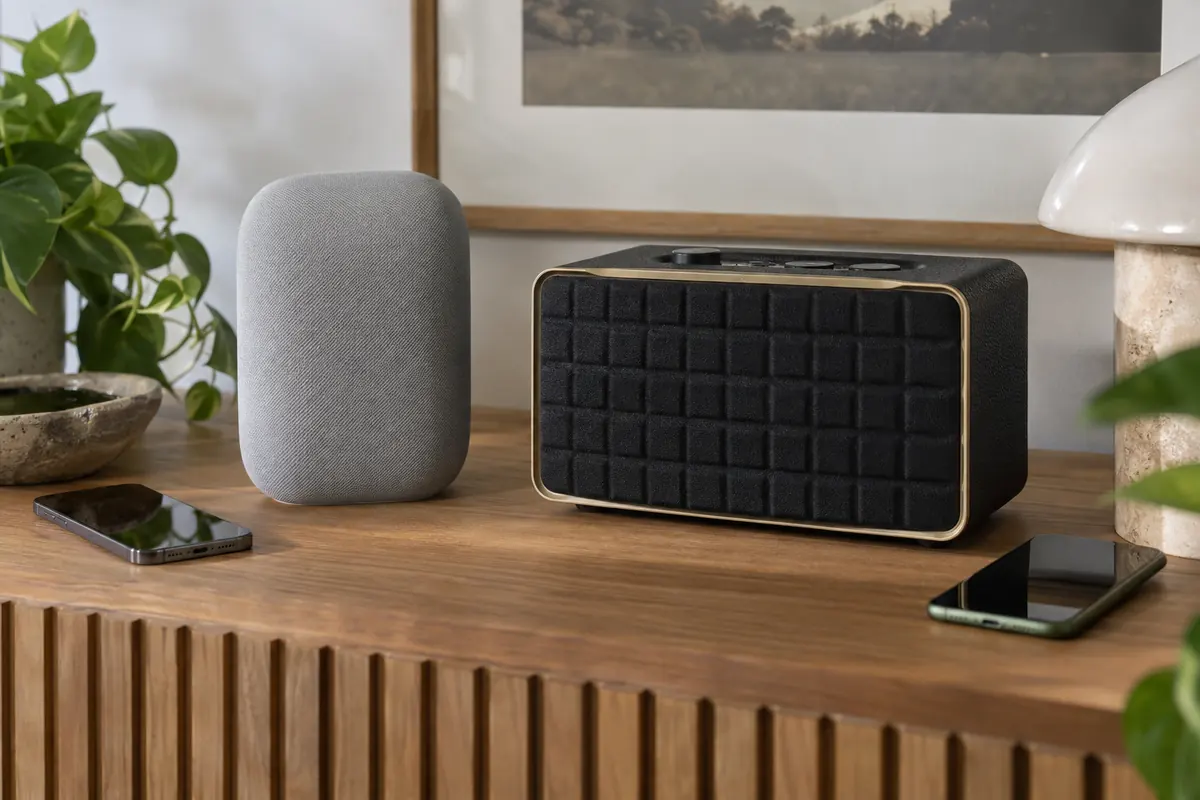
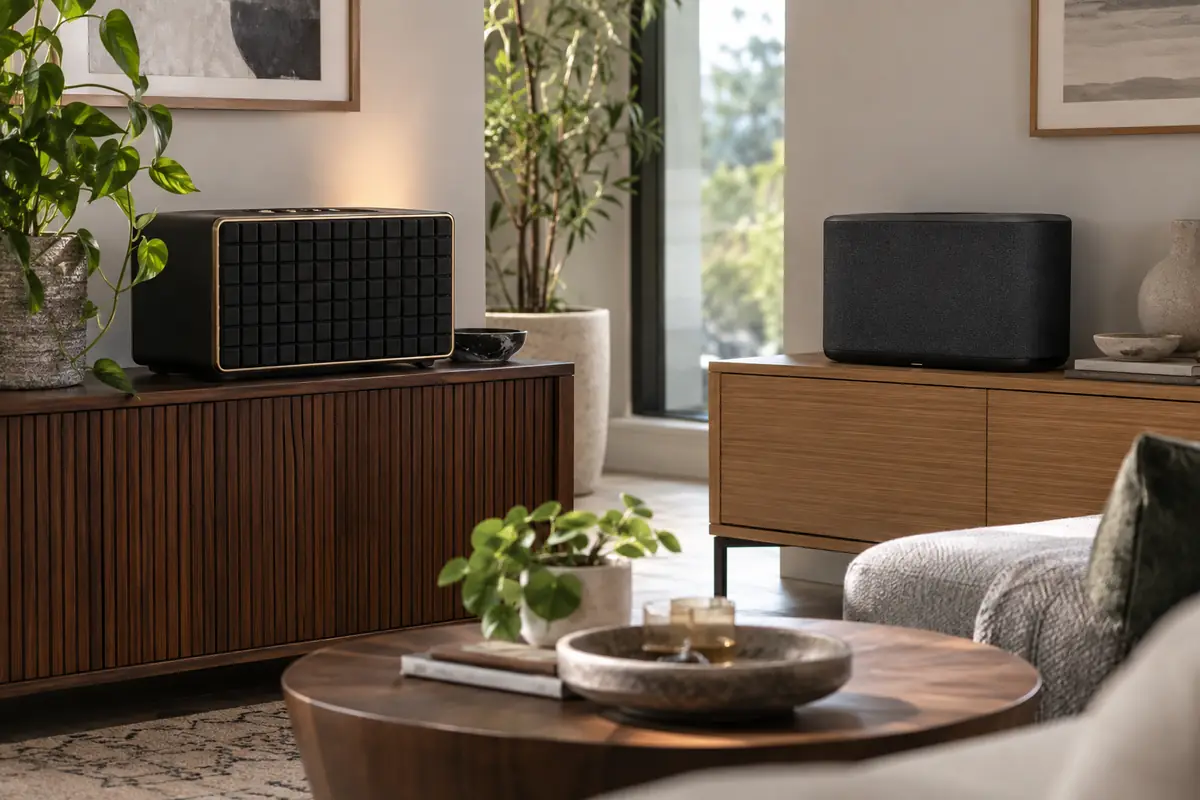
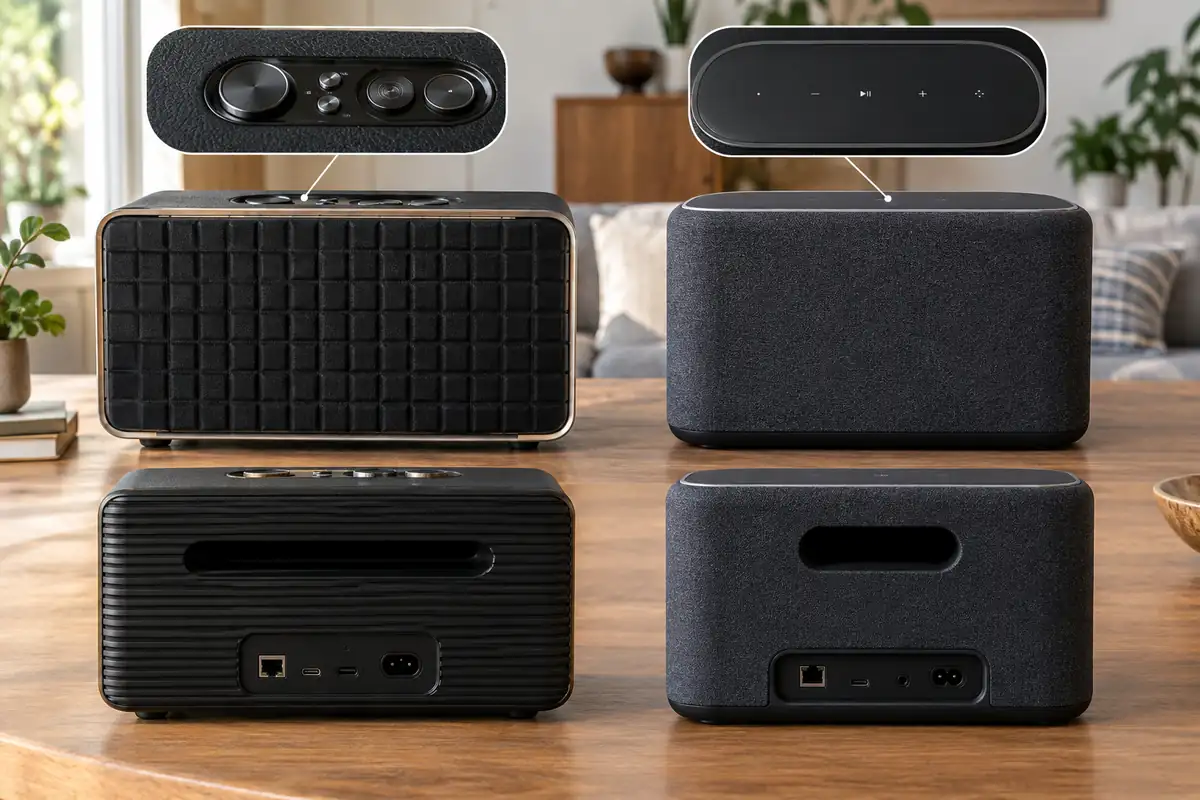
JBL Authentics 500 is visually assertive, with a patterned grille, metal frame, and physical controls that reference classic JBL equipment. Its cabinet needs a substantial shelf or console and enough space for drivers and passive radiators to work without excessive corner bass. Denon Home 350 is more understated but still large and heavy, using two tweeters, two midrange drivers, and two woofers in a stereo arrangement. To compare more JBL options, see our Google Nest Audio vs JBL Authentics 200 guide. Touch controls sit on top, and the rear inputs reward placement near network and source cables. Neither is portable; both need continuous AC power and ventilation. Measure furniture depth and cable bend radius, and keep vibration-sensitive turntables off the same unstable surface.
Performance
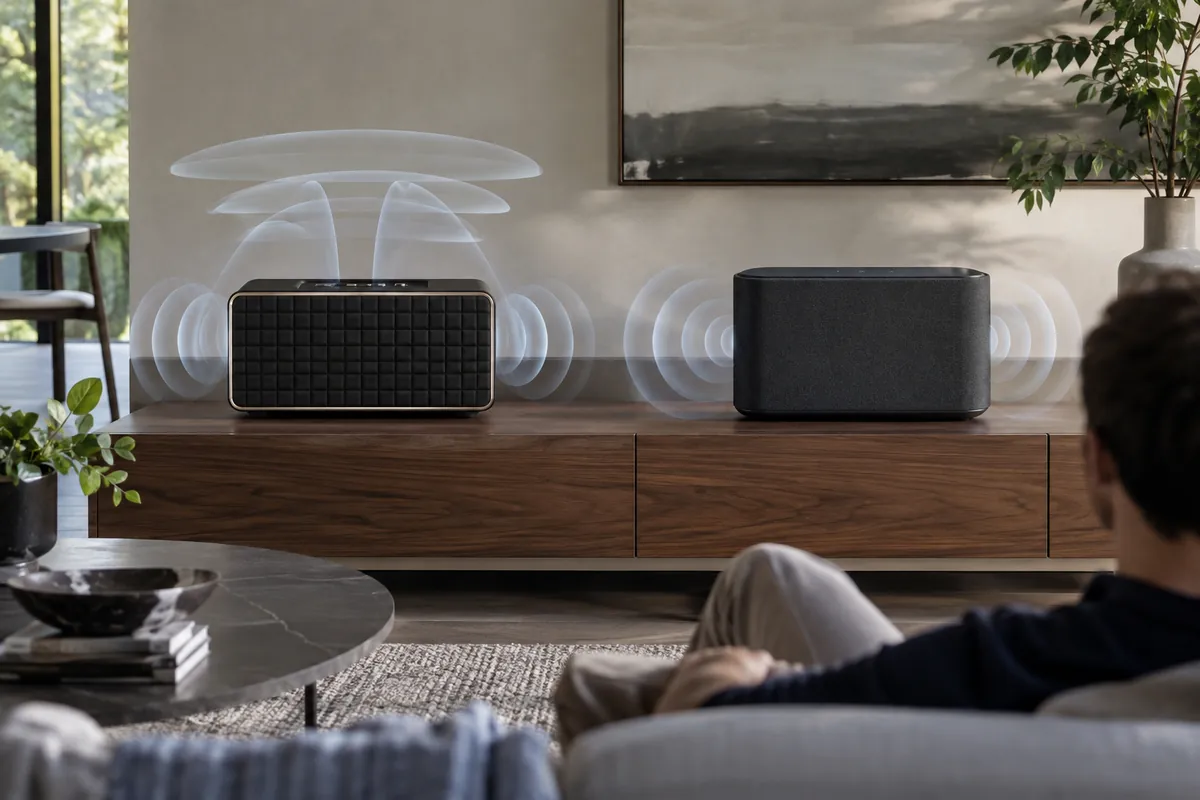
Authentics 500 is designed to create a broad, powerful presentation and can decode supported Dolby Atmos Music for added spatial information from one cabinet. Atmos results depend on the mix, service tier, room, position, and listening location; one speaker cannot reproduce the separation of a calibrated multichannel system. Denon Home 350 focuses on strong stereo playback from six drivers and can form a wider pair with a second matching unit.
Its large woofers suit bass-rich material, while app EQ helps adjust boundaries. JBL’s self-tuning adapts automatically after placement. Denon relies more on user placement and controls. Audio preference cannot be settled from driver count or watts alone, so buyers should prioritize source support, room size, vocal clarity, and bass behavior at their normal level.
Smart Features
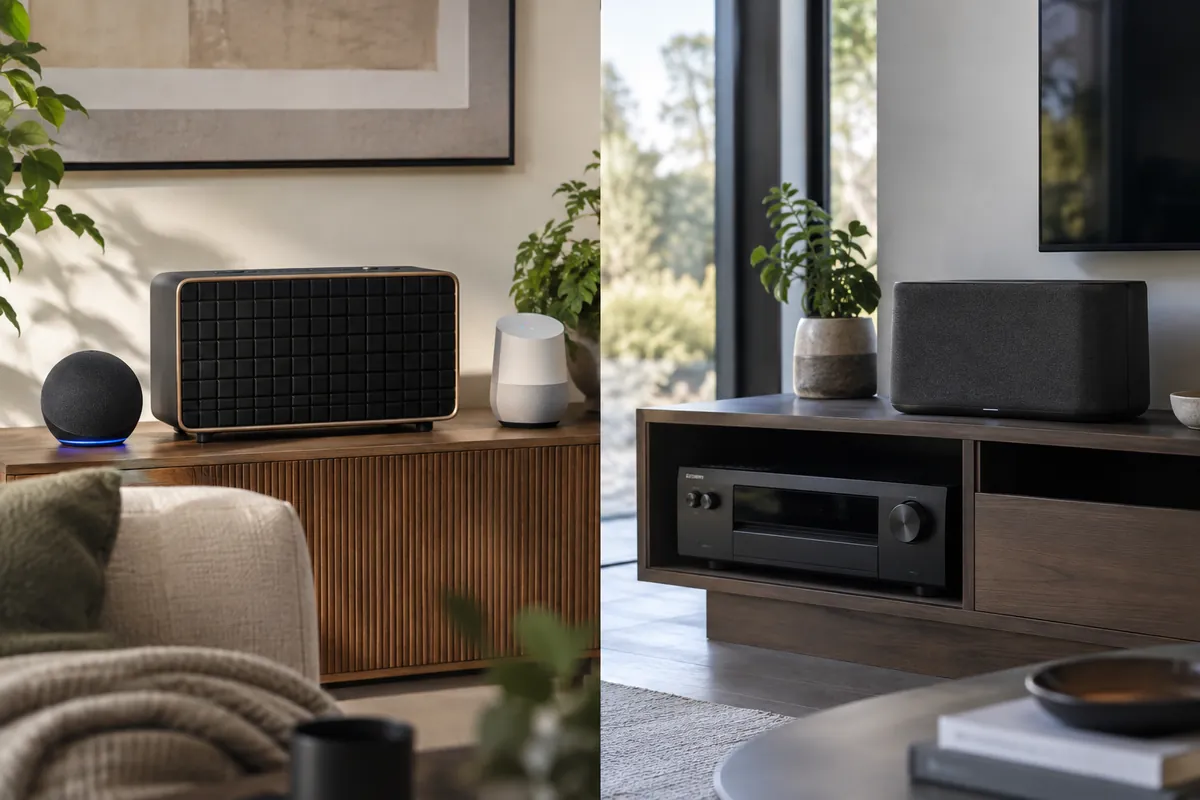
JBL’s defining smart feature is support for Alexa and Google Assistant on the same speaker, reducing the need to choose one voice platform for music and general commands. Denon Home 350 includes Alexa support and can participate in Apple playback through AirPlay 2; Siri requests originate through compatible Apple devices. Voice availability varies by region and linked service, and neither assistant guarantees direct playback from every music provider. Physical presets or favorite buttons can be more dependable for routine stations. Microphone controls should be easy for every household member to find.
App Experience
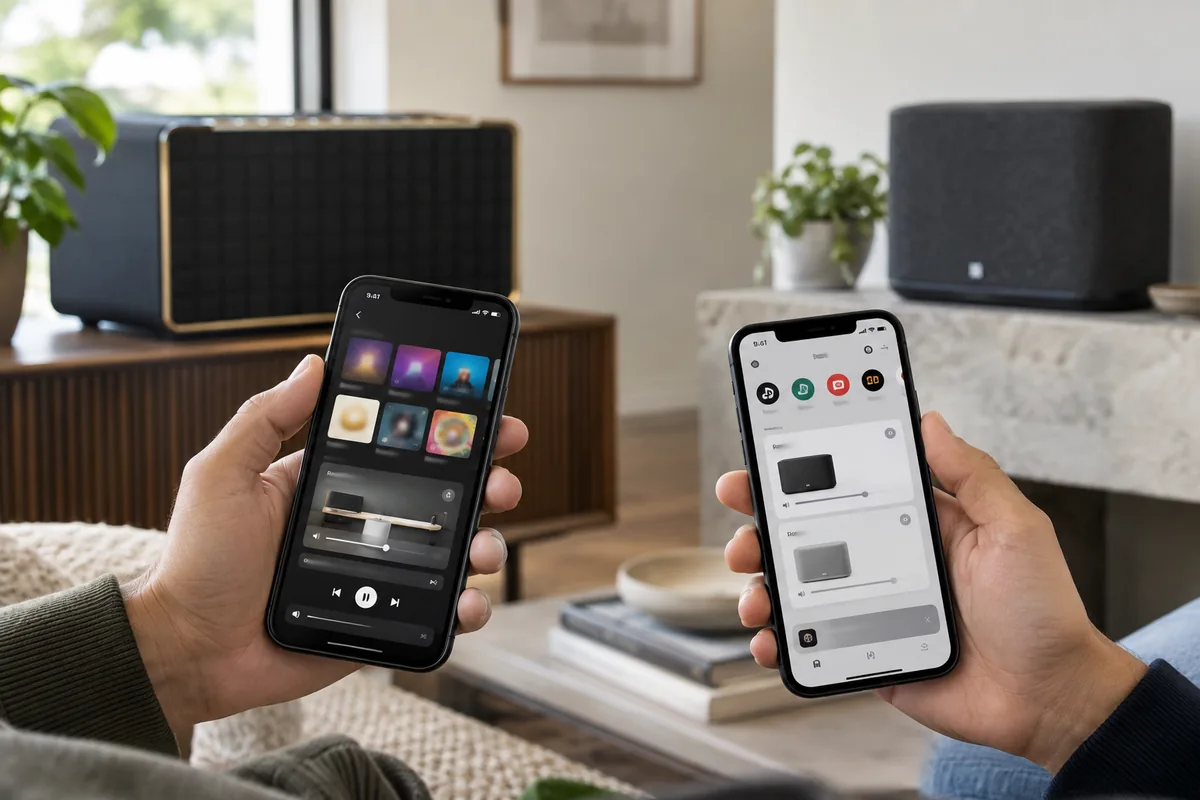
JBL One handles setup, service linking, EQ, personalization, updates, and supported multiroom behavior. Denon’s HEOS app is a deeper whole-home audio controller, bringing together streaming accounts, USB or analog sources, rooms, favorites, and compatible Denon or Marantz components. HEOS is especially valuable when a receiver already anchors the living room. Buyers starting from one speaker may find JBL’s approach more direct. Test search, queue behavior, household profiles, local-library access, and how a physical input is shared before committing to several rooms.
Compatibility / Ecosystem
Authentics 500 supports several interoperable paths—AirPlay, Chromecast, Spotify Connect, and assistant-based grouping—without making those systems identical. Denon Home 350’s strongest ecosystem is HEOS, where it can join compatible speakers, soundbars, and receivers, while AirPlay 2 offers an Apple path and Roon support appeals to some library-focused listeners. For a different set of smart speakers trade-offs, read our Bose Portable Smart Speaker vs Sonos Move 2 guide. A device appearing in several apps does not mean a group started in one technology can be edited in another. Choose one primary multiroom method and verify every planned room device supports it.
Privacy / Security
Both speakers can use always-available microphones for voice services. Review the hardware microphone control, indicator behavior, stored voice history, linked household accounts, and purchase permissions. JBL’s two-assistant capability means two cloud ecosystems may be active; disable one if it provides no value. Denon users who do not need Alexa can turn off the relevant microphone behavior and still use HEOS playback. Protect JBL, HEOS, Amazon, Google, and music-service accounts with unique passwords and remove former household users. Network segmentation can add another layer for connected audio devices.
Key Differences
Atmos Music versus conventional stereo
JBL emphasizes immersive mixes from one cabinet. Denon emphasizes a strong left-right presentation and can form a matching stereo pair. Atmos catalog availability and service tiers matter; ordinary stereo libraries may favor Denon’s more conventional approach.
Assistant flexibility
JBL can keep Alexa and Google Assistant available together, a rare advantage in mixed-assistant homes. Denon centers on Alexa and Apple playback paths. If voice is secondary, physical inputs and multiroom architecture should carry more weight.
HEOS integration
Denon Home 350 can share sources and rooms with compatible Denon and Marantz equipment through HEOS. JBL offers broad casting protocols but lacks the same receiver-centered ecosystem. Existing audio hardware can make this decision straightforward.
Source connections
Denon clearly supports USB, analog input, and Ethernet alongside wireless services. JBL provides useful network and input options, but Denon is the more natural local-source component. If you are still comparing smart speakers, our Amazon Echo Dot Max vs Sonos Era 100 breakdown covers another relevant pairing. Check whether a turntable needs a separate phono preamp.
Who JBL Authentics 500 Is Best For
JBL Authentics 500 is best suited to buyers with these priorities:
- Mixed Alexa and Google households that want both assistants.
- Listeners with access to Dolby Atmos Music catalogs.
- Rooms where JBL’s bold design is part of the appeal.
- Users who prefer Chromecast alongside AirPlay and Spotify Connect.
Who Denon Home 350 Is Best For
Denon Home 350 is the better match in these situations:
- Existing HEOS, Denon, or compatible Marantz households.
- Listeners who use USB, analog sources, Ethernet, or Roon.
- Buyers who favor conventional stereo presentation and pairing.
- Rooms where a quieter visual design fits better.
FAQ
Does JBL Authentics 500 need a battery charge?
No. It is an AC-powered home speaker, not a portable model. Denon Home 350 also requires AC power. Plan a stable surface and outlet rather than expecting either to move freely to a patio.
Can JBL really use Alexa and Google Assistant together?
JBL designed the Authentics line to make both available on the device, subject to region, accounts, and current service support. Each assistant still has its own music-service and command limitations.
Is one JBL speaker a true surround system?
No. Dolby Atmos Music can create spatial effects from supported mixes, but a single cabinet does not provide the discrete placement of a multichannel speaker system around the listener.
Can Denon Home 350 connect to a turntable?
Its analog input can accept a line-level source. A turntable without a built-in phono stage needs an external preamp. Keep the turntable isolated from vibration produced by the speaker’s woofers.
Can these speakers join the same multiroom group?
They can share some broad protocols such as AirPlay 2 in compatible Apple use, but JBL-native and HEOS-native grouping are separate. Do not expect every input, control, or synchronization feature to cross brands.
Which sounds better?
That depends on room, placement, source quality, preferred bass, listening level, and whether Atmos mixes matter. JBL prioritizes immersive impact and self-tuning; Denon prioritizes stereo hardware and HEOS flexibility.
Final Summary
JBL Authentics 500 is the more adventurous smart speaker, pairing large-scale sound and Dolby Atmos Music with Alexa and Google Assistant on one device. Denon Home 350 is the more conventional networked hi-fi speaker, with six-driver stereo sound, HEOS, rich local connectivity, AirPlay 2, and Roon support. Choose JBL for immersive catalogs, dual assistants, and broad casting. Choose Denon for an existing receiver ecosystem, local sources, or a stereo-first approach. Both need careful placement, AC power, secure accounts, and a confirmed list of music services before purchase.