Introduction
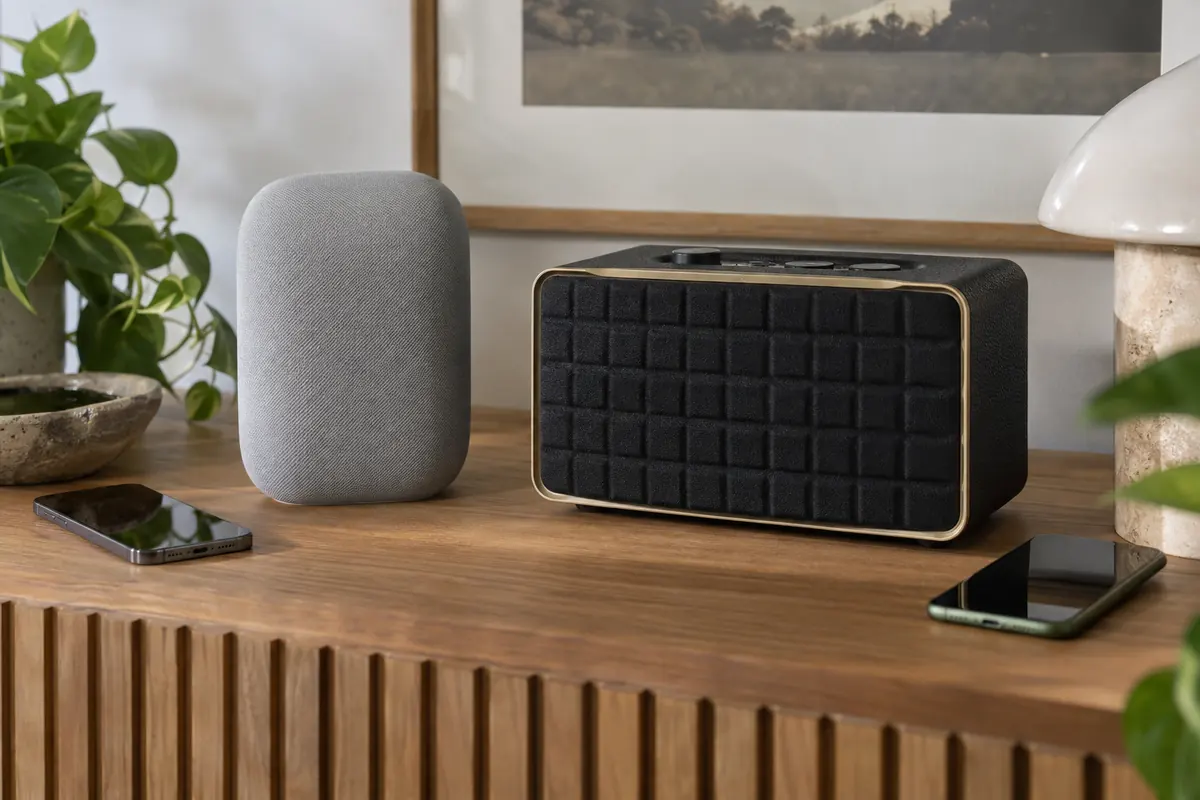
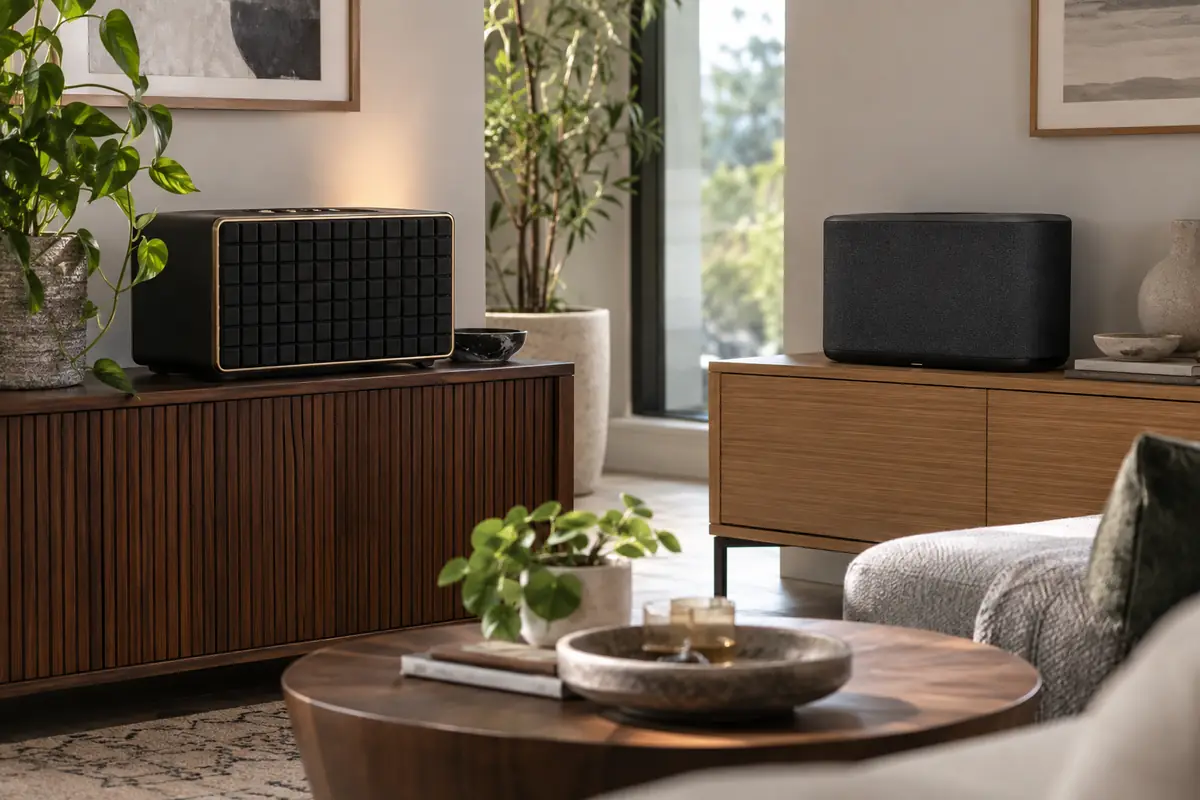
Google Home Speaker vs Sonos Era 100 compares two Wi-Fi and Bluetooth speakers that prioritize different jobs. Google’s speaker is a Gemini-first smart-home interface with one 58 mm driver and Matter/Thread hub functions. Era 100 is a music-focused wireless speaker with two angled tweeters for stereo separation, a midwoofer, Trueplay tuning, AirPlay 2, and optional USB-C line-in or Ethernet adapters.
The choice is best framed as assistant intelligence versus audio flexibility, not as a universal winner. Era 100 supports voice features available in the Sonos platform, but it is not a Google Gemini smart speaker. Google is not designed as a direct substitute for Era 100’s larger acoustic system. This guide uses official specifications rather than claimed listening tests.
Quick Answer
In the Google Home Speaker vs Sonos Era 100 comparison, choose Google Home Speaker if Gemini for Home, Matter control, a Thread border router, compact size, and a lower-complexity voice interface are the priorities. Choose Sonos Era 100 if music playback, true stereo from one enclosure, Trueplay room tuning, AirPlay 2, Bluetooth 5.0, and optional line-in matter more. Google is better as the conversational smart-home endpoint; Sonos is better as the versatile music speaker.
Comparison Table
| Feature | Google Home Speaker | Sonos Era 100 |
|---|---|---|
| Primary purpose | Gemini smart-home speaker | Music and multiroom speaker |
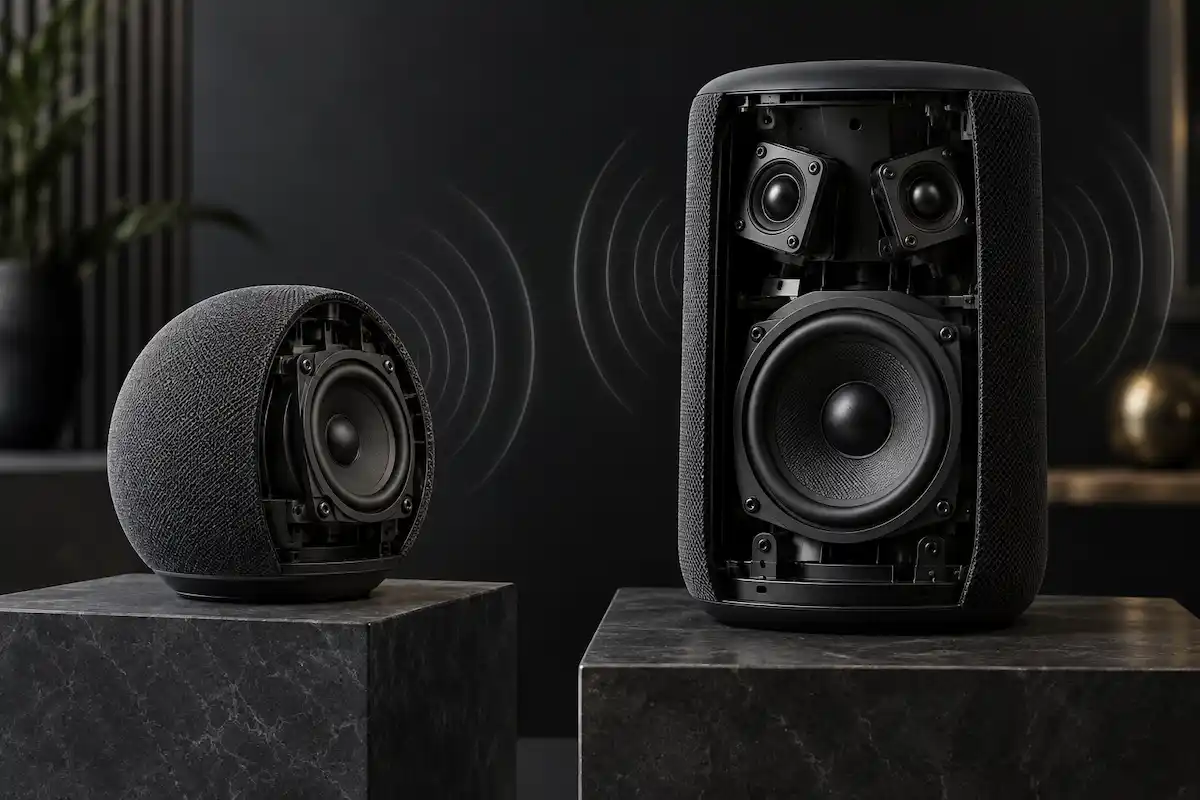
| Drivers | 58 mm full-range driver | Two angled tweeters and one midwoofer |
| Room tuning | Automatic sound adaptation features | Trueplay on iOS and Android |
| Wi-Fi | Wi-Fi 6, 2.4/5 GHz | Wi-Fi 6 compatible, 2.4/5 GHz |
| Bluetooth | Bluetooth 5.4 | Bluetooth 5.0 audio streaming |
| Apple streaming | Check current casting/service support | AirPlay 2 |
| Wired input | None listed | USB-C line-in or Ethernet with optional adapters |
| Smart-home hub | Matter hub and Thread border router | Not a general Matter/Thread hub |
Google Home Speaker vs Sonos Era 100: Key Differences
Assistant-first versus audio-first design
Google built its speaker around Gemini conversations, voice match, home control, and a modest omnidirectional driver. Sonos built Era 100 around playback: two tweeters create left-right separation and a midwoofer handles vocals and bass. Sonos voice options can control supported music and system actions, but do not reproduce Gemini’s general assistant role. For another comparison featuring Sonos Era 100, see Amazon Echo Dot Max vs Sonos Era 100. Decide whether most interactions begin with a question or with pressing play. That assistant-first versus audio-first split defines Google Home Speaker vs Sonos Era 100.
Inputs and streaming
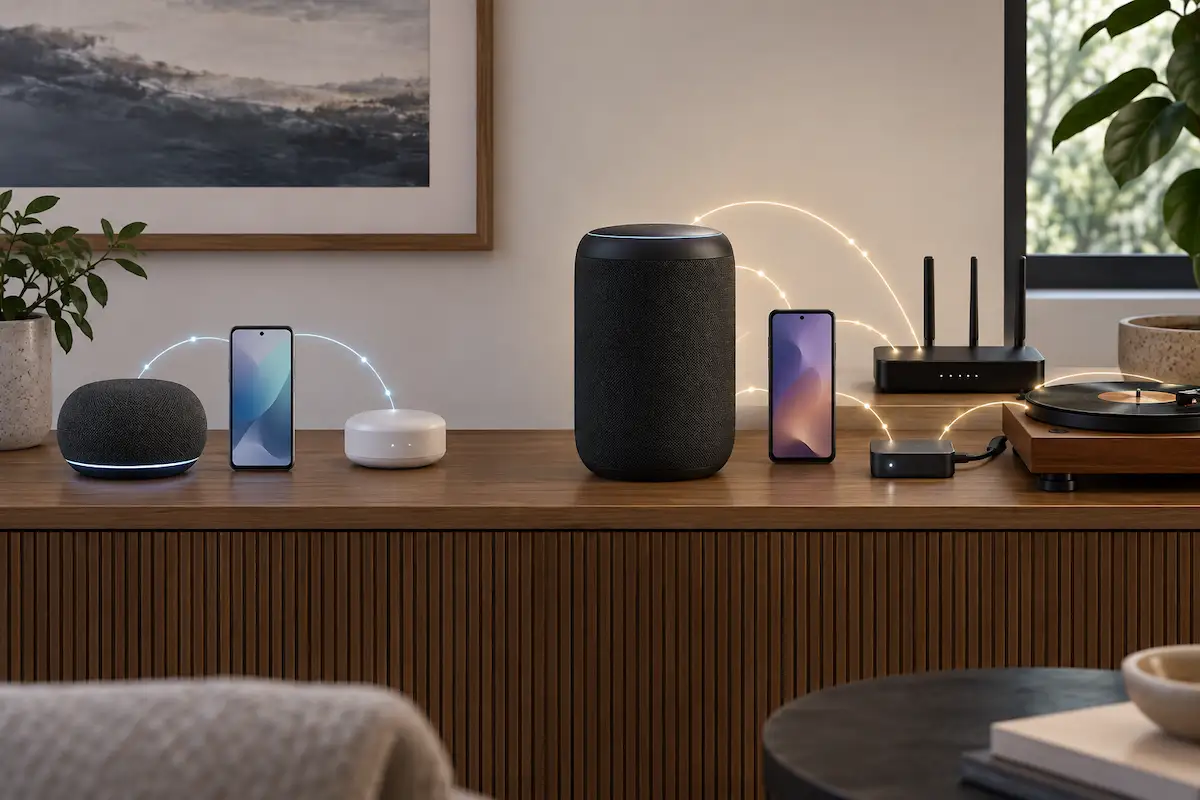
Era 100 accepts Bluetooth audio, AirPlay 2, network services, and optional analog line-in through a Sonos adapter. An optional combo adapter can add Ethernet. Google also has Bluetooth and network playback but does not list an equivalent line input. A turntable or legacy source strongly favors Sonos, although a suitable preamp may still be required. Google favors service-based and cast-style workflows inside its ecosystem.
Smart-home infrastructure
Google Home Speaker is a Matter hub and Thread 1.3 border router, allowing it to help connect compatible locks, lights, and sensors. Era 100 does not fill that general hub role. Sonos can participate in automations and voice control through supported services, but its central purpose is the Sonos audio system. If another home hub already exists, Google’s infrastructure advantage may be redundant; if not, it can be significant.
Size and placement
Google’s speaker is 3.4 inches tall, 4.2 inches in diameter, and 0.9 pounds including its captive cable. Era 100 is 7.18 by 4.72 by 5.14 inches and 4.44 pounds. Sonos needs more shelf space but its driver separation benefits from thoughtful orientation. Google fits desks and counters more easily. Keep both clear of water, heat, and enclosed cabinets, and preserve access to microphone controls.
Major Features Compared
Multiroom systems
Sonos has a mature whole-home audio architecture with grouping, stereo pairing, and broad service control. Google supports speaker groups and broadcast functions in Google Home. Existing rooms should decide the purchase: mixing ecosystems can mean two grouping systems that do not synchronize as one. If television audio is planned, verify compatible soundbar and surround configurations rather than assuming any two smart speakers can act as TV speakers.

Room tuning and equalization
Era 100 uses Trueplay to measure room acoustics and tune the speaker, with supported workflows on iOS and Android; the Sonos app also exposes bass, treble, and loudness. Google describes automatic sound behavior within its speaker platform but offers a different level of audio focus. The Google Home Speaker vs Apple HomePod guide gives Google Home Speaker a different point of comparison. Tuning can reduce some placement problems but cannot overcome a speaker buried in a cabinet or placed in a resonant corner.
Microphone privacy
Google includes a two-stage hardware mic mute switch. Era 100 includes a speech-bubble control and a rear switch that disconnects power to the microphone hardware. Sonos provides a particularly explicit physical disconnection. For either, learn the status lights and separate microphone privacy from account privacy. Playback histories, voice services, household permissions, and cloud records require their own settings.
Subscriptions and service dependence
Some enhanced Gemini capabilities require Google Home Premium. Sonos does not require a subscription merely to operate Era 100, but music providers may require their own plans. Calculate ongoing costs around the services you actually use. Also check whether voice start, search, lossless formats, or spatial formats are supported by the chosen service on that platform, because a logo alone does not describe the complete experience.
How to Choose for Your Home
When weighing Google Home Speaker vs Sonos Era 100, rank three needs: audio quality, assistant capability, and smart-home role. Confirm the music services each platform can start directly, whether casting or Bluetooth is available, and what a paid subscription adds. Check which household phones can complete setup, how personal results and voice profiles work, and whether microphone mute physically disconnects hardware. For stereo or television use, confirm that the exact models can pair in the intended configuration. Smart assistants and generative features evolve through software, so buy for useful functions available now. A speaker placed away from walls at a practical listening height usually has a better chance of performing as designed.
Who Google Home Speaker Is Best For
Google Home Speaker is best as an assistant in a Google-centered room. It provides smart-home infrastructure and conversational help in a much smaller package than Era 100.
- Google Home households wanting Gemini in more rooms.
- Matter homes needing a Thread border router.
- Desks and counters with limited space.
- Users who prioritize questions, routines, and home control over audio scale.
Who Sonos Era 100 Is Best For
Era 100 is best for listeners building a flexible Sonos music system. Our Sonos Era 300 vs Apple HomePod comparison offers another perspective on Sonos products. Its multiple drivers, Trueplay, AirPlay 2, Bluetooth, and optional wired input make it much more adaptable for serious playback.
- Music-first rooms and existing Sonos households.
- Apple users wanting AirPlay 2.
- Turntable or wired-source setups using the correct adapter and preamp.
- Users who value a hardware microphone power switch.
Frequently Asked Questions
The following Google Home Speaker vs Sonos Era 100 questions cover voice assistants, wired sources, Bluetooth, Apple streaming, and stereo pairing.
Does Sonos Era 100 support Gemini?
No. Era 100 supports voice options available in the Sonos ecosystem, but it is not a Gemini for Home endpoint equivalent to Google Home Speaker.
Which speaker supports line-in?
Era 100 supports analog line-in through its USB-C port using the appropriate Sonos adapter. Google Home Speaker does not list a comparable audio input.
Can both stream over Bluetooth?
Yes, both list Bluetooth. Era 100 explicitly supports Bluetooth audio streaming; verify Google’s current pairing behavior and supported codecs for your intended source.
Which is better for Apple users?
Era 100’s AirPlay 2 support makes it easier to stream from Apple devices. Google Home Speaker works on iOS through Google Home but remains centered on Google services and Gemini.
Can Era 100 control Matter devices?
It is not documented as a general Matter controller or Thread border router. Google Home Speaker is. Sonos voice and smart-home integrations are a separate capability.
Can I stereo-pair the speakers?
Each platform has its own supported pairing rules, normally requiring matching models. A Google speaker and an Era 100 cannot form a cross-brand stereo pair.
Final Comparison Summary
Google Home Speaker vs Sonos Era 100 comes down to assistant intelligence versus audio flexibility. Google Home Speaker wins for Gemini, routines, Matter, Thread, and compact smart-home coverage. Sonos Era 100 wins for driver hardware, stereo presentation, Trueplay, AirPlay 2, multiroom music, and optional wired sources. If the room needs a helpful voice endpoint, choose Google. If it needs a capable music system that can accept more sources, choose Sonos. Existing ecosystem investment, not an isolated specification, should break a close decision.