Introduction
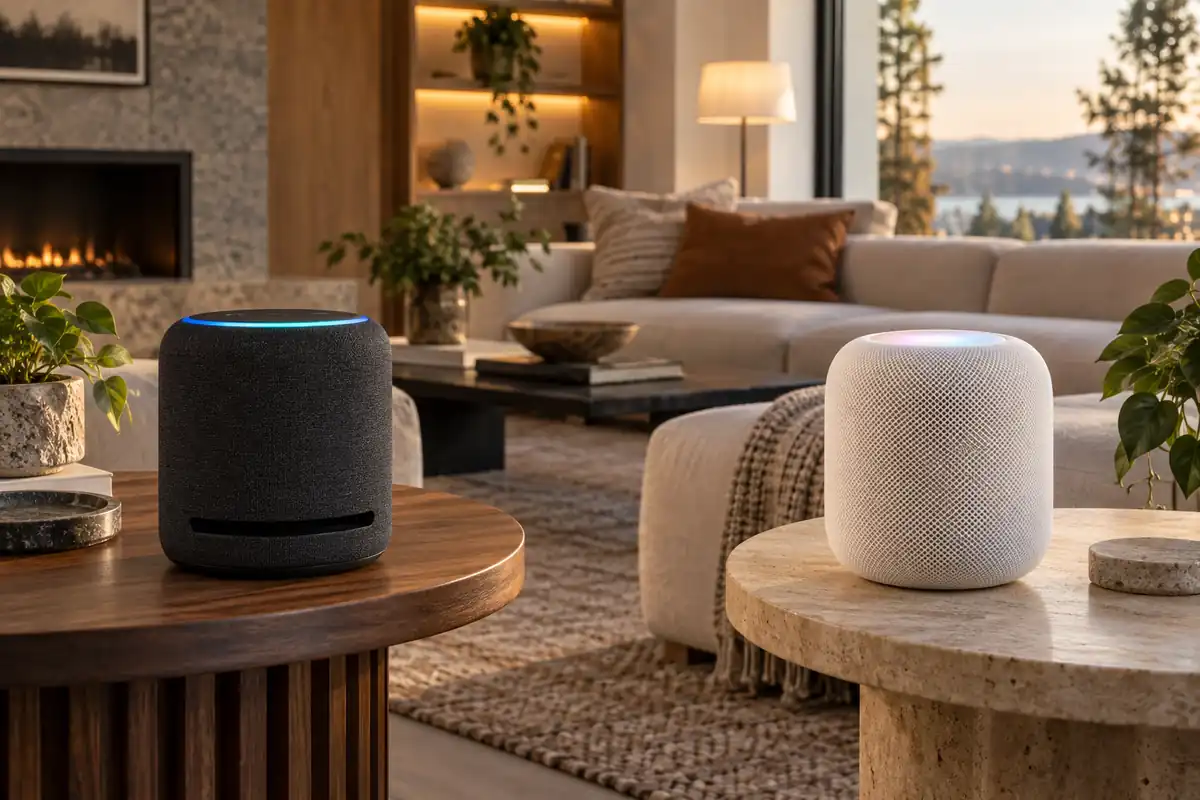
Amazon Echo Studio vs Apple HomePod compares two current products aimed at the same broad buyer, but their hardware, storage or ecosystem assumptions are not interchangeable. The current 2025 Echo Studio is built around Alexa+, room-adapting spatial audio, and Amazon’s smart-home platform. HomePod second generation combines computational audio, Siri, Apple Music, AirPlay, Thread, and close Apple TV integration.
This guide uses current manufacturer specifications and support material rather than claiming personal testing. Published detection ranges, battery estimates, brightness, audio performance, and other laboratory results depend on settings and surroundings. Confirm the exact US model, included accessories, current firmware, and subscription terms before buying, because similarly named regional packages can differ.
Quick Answer
Choose Amazon Echo Studio if Alexa+, broad voice-service access, Fire TV home theater, and Amazon’s Matter and Thread smart-home role are priorities. Choose Apple HomePod if the household already uses iPhone, Apple Music, Apple TV 4K, AirPlay, HomeKit, and Siri. For another comparison featuring Apple HomePod, see Sonos Era 300 vs Apple HomePod. Both support Dolby Atmos and room-aware tuning, but neither is a neutral Bluetooth speaker with every service. Echo Studio is the more flexible Alexa hub; HomePod is the more cohesive Apple speaker.
Comparison Table
| Feature | Amazon Echo Studio | Apple HomePod |
|---|---|---|
| Current model | Echo Studio, 2025 release | HomePod, 2nd generation |
| Spatial audio | Room-adapting spatial audio with Dolby Atmos | Spatial Audio with Dolby Atmos |
| Assistant | Alexa / Alexa+ availability by account | Siri |
| TV pairing | Compatible Fire TV Alexa Home Theater | Apple TV 4K home theater |
| Smart-home role | Matter controller and Thread border router | Apple home hub and Thread border router |
| Direct phone playback | Alexa services and supported casting/Bluetooth behavior | AirPlay from Apple devices |
| Sensors | Omnisense inputs for supported routines | Temperature and humidity; alarm sound recognition |
| Best ecosystem | Amazon/Alexa/Fire TV | Apple/HomeKit/Apple TV |
Key Differences
Alexa+ or Siri
Echo Studio’s AZ3 Pro silicon and Omnisense platform are designed for Amazon’s newer Alexa+ experiences, though availability, subscriptions, and specific capabilities can vary. HomePod uses Siri for requests, personal results, intercom, timers, and Apple Home control. Alexa generally reaches more third-party skills and services; Siri is tightly integrated with Apple accounts. Choose the assistant the household can administer, not the one with the longest feature list.
How music reaches the speaker
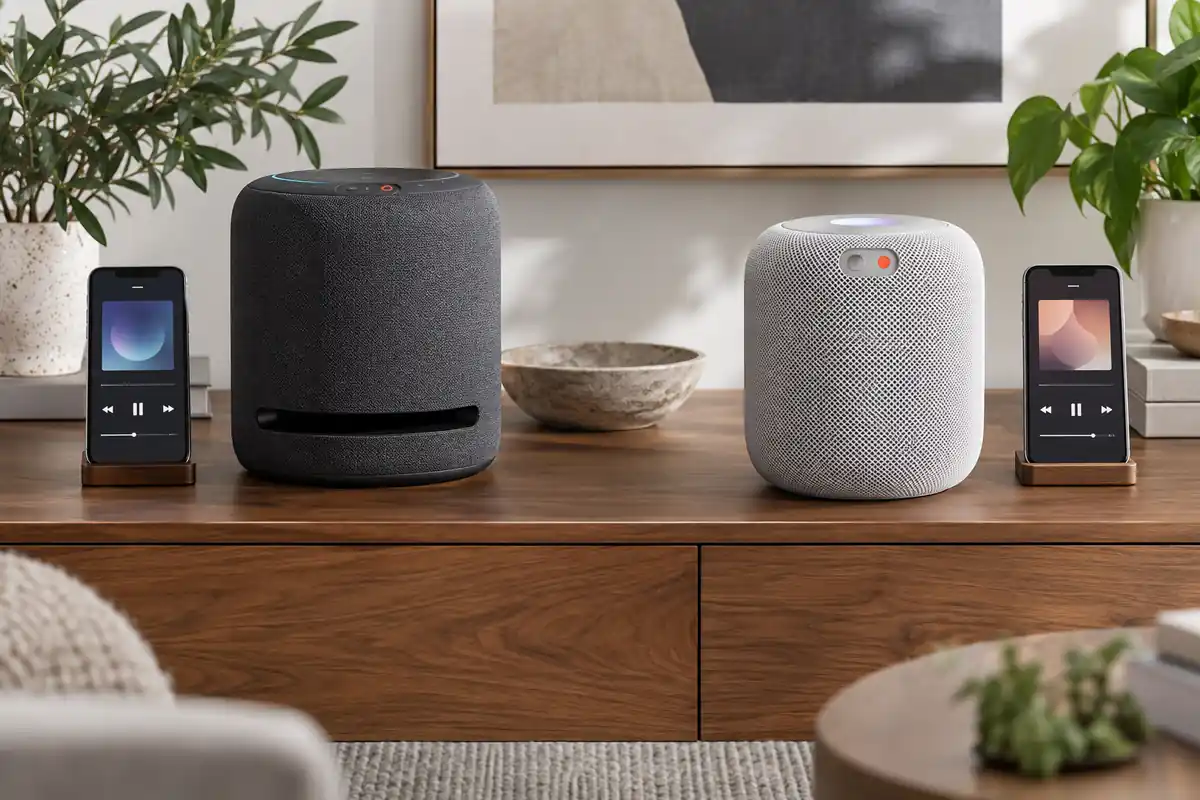
Echo Studio is centered on services linked inside Alexa and Amazon’s playback controls. HomePod is optimized for Apple Music and can receive other compatible audio over AirPlay from iPhone, iPad, Apple TV, or Mac. HomePod lists Bluetooth 5.0 for device functions but is not a conventional Bluetooth audio speaker. Confirm that the exact music service supports voice-started playback rather than assuming every phone app behaves the same.
Television audio
A current Echo Studio can join supported Fire TV devices through Alexa Home Theater, including multi-speaker configurations documented for the 2025 model. HomePod pairs most naturally with Apple TV 4K, and two identical HomePods can create a stereo pair with Dolby Atmos support. Neither is a universal HDMI soundbar. The television source, streaming box, Wi-Fi reliability, and allowed speaker combination determine what works.
Smart-home hub duties
Both can help run Matter devices and provide Thread border-router connectivity, but each lives inside a different administration model. Echo Studio uses the Alexa app and Amazon account; HomePod uses Apple Home and a household’s Apple IDs. A shared standard does not make automations, cameras, locks, announcements, or user permissions identical. Check every critical accessory in the target ecosystem before consolidating around either speaker.

Major Features Compared
Everyday performance and its limits
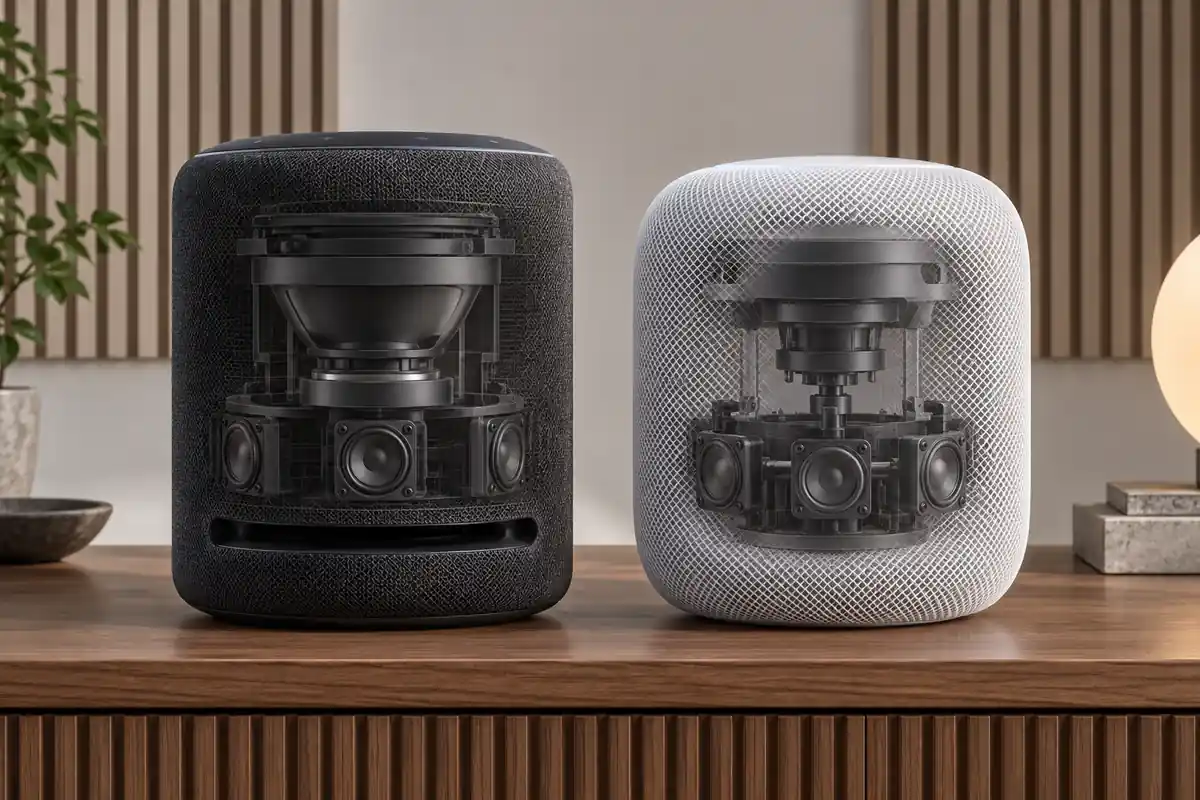
Both manufacturers use room analysis and processing to adapt playback, and both promote immersive audio rather than publishing a simple wattage contest. HomePod uses a four-inch high-excursion woofer and five-tweeter array. Amazon describes the compact 2025 Studio as a premium spatial speaker. Room size, placement, walls, listening position, source mix, and mastering influence the result more than a driver count alone. Manufacturer numbers are useful for identifying design intent, but they are not a substitute for placement, setup, and maintenance. Compare the complete workflow rather than awarding the decision to one larger number.
Apps, ecosystems, and privacy
Echo Studio serves Alexa routines, compatible Fire TV systems, and Amazon household profiles. HomePod serves as an Apple home hub, supports Thread, exposes temperature and humidity readings, and works with Apple TV, AirPlay, and Siri personal requests. Personalization requires careful voice profiles and account permissions. Review purchase and messaging controls before placing either speaker in a shared room. The Google Home Speaker vs Apple HomePod guide gives Apple HomePod a different point of comparison. Platform support can change by region or firmware. Protect the account with a unique password and multifactor authentication where offered, review household permissions, and enable only the cloud or sensing functions you plan to use.
Installation and long-term ownership
Give each speaker stable Wi-Fi, an open surface, and some clearance from corners before judging bass or room tuning. Do not hide microphones behind a television or inside a cabinet. Test microphone-off controls, guest playback, explicit-content settings, and household profiles. Stereo pairs normally require matching models and double the outlet, shelf, and network requirements. Before the return window closes, test the difficult real-world conditions, document settings that work, and price required accessories or consumables. A product that is easy to service is usually a better long-term choice than one with an impressive feature you rarely use.
How to Choose for Your Home
Rank audio quality, assistant behavior, and smart-home control before picking a platform. Confirm that your preferred music service can start directly, whether Bluetooth or AirPlay is available, and which paid plans unlock requested tracks. Check voice profiles, personal results, household accounts, microphone controls, and the exact requirements for stereo or TV pairing. Software features change, so buy for capabilities available on the exact model today. Placement also matters: a little breathing room and a stable surface can improve sound.
Who Amazon Echo Studio Is Best For
Amazon Echo Studio is the more natural choice when its defining hardware and platform match the way the product will be used every day.
- Alexa households adopting the current 2025 Echo platform.
- Fire TV users who want a documented Alexa Home Theater route.
- Matter homes administered primarily through the Alexa app.
- Listeners whose preferred services support direct Alexa playback.
Who Apple HomePod Is Best For
Apple HomePod makes more sense when its different balance of capability, storage, controls, and maintenance solves the more important problem.
- iPhone, Apple Music, and Apple TV 4K households.
- Apple Home users needing a home hub and Thread border router.
- Listeners who frequently send audio through AirPlay.
- Rooms where temperature, humidity, or alarm-sound features add value.

Frequently Asked Questions
Which speaker sounds better?
There is no universal answer without the room, source, volume, and listening preferences. Both apply room-aware processing and support spatial audio. Our Apple HomePod Mini vs Amazon Echo Dot comparison offers another perspective on Amazon products. Buy from a retailer with a suitable return period and compare at matched loudness using the services you actually use.
Can HomePod play Bluetooth audio from Android?
No, not like a normal Bluetooth speaker. Apple lists Bluetooth hardware, but HomePod audio playback is designed around supported services and AirPlay from Apple devices. Android-centered homes should not assume direct Bluetooth streaming.
Does Echo Studio require Alexa+?
The speaker still belongs to the Alexa ecosystem, while Alexa+ availability and commercial terms can vary by account and region. Evaluate useful functions available to the household now instead of buying only for a service rollout.
Can either replace a soundbar?
They can provide satisfying TV audio in their supported Fire TV or Apple TV configurations, especially as pairs, but lack the universal wired inputs and predictable lip-sync path of many soundbars. Verify the exact television setup first.
Do both control Matter devices?
The current models provide Matter-related hub capabilities, including Thread border-router roles. Device type support and advanced features still depend on Alexa or Apple Home. Check the accessory’s current compatibility documentation.
Which offers better privacy controls?
Both provide microphone controls and account privacy settings, but their cloud processing, histories, household permissions, and personalization differ. Review and delete voice history as desired, restrict purchases, and use hardware mute when microphones are not wanted.
Final Comparison Summary
Amazon Echo Studio is the stronger choice for an Alexa-first household that wants the 2025 hardware, Alexa+, Fire TV pairing, and Amazon smart-home administration. Apple HomePod is the cleaner fit for iPhone, Apple Music, Apple TV 4K, AirPlay, and Apple Home users. Both can deliver room-tuned Dolby Atmos audio, so the real separator is the ecosystem surrounding the speaker. Confirm music-service control, TV compatibility, household permissions, and current assistant features before comparing sound in the intended room.